
5 Pillars of Financial Literacy in Modern Nigeria: Your Guide to Financial Freedom
September 13, 2025
Nigeria’s Future: Our Next Generation Needs Financial Literacy — Not Later, Now
October 3, 2025From Dribbles to Dollars: How Okocha’s Financial Discipline Offers Blueprint for Financial Success

How Nigeria’s football legend turned early financial awareness into lasting wealth through strategic planning and disciplined spending
In a country where stories of fallen sports heroes struggling financially have become all too common, Augustine “Jay-Jay” Okocha stands as a beacon of what proper financial planning can achieve. The legendary Super Eagles captain’s recent revelations about his financial journey offer invaluable lessons for every Nigerian seeking to build lasting wealth, regardless of their career path.
The Reality Check That Changed Everything
Okocha’s financial awakening came early in his career, around age 23-24, when he made a crucial discovery about wealth generation. As he explains: “It hit me when I first bought my commercial property in Nigeria and in England. So you buy a property that you think you’ve paid huge money (for), but the income it generates in a month, that’s not much. So, I now realised that for me to be going home every month with $10,000, I needed to invest millions.”
This moment of clarity represents a fundamental principle of financial literacy: understanding the difference between spending money and making money work for you. For most Nigerians earning modest salaries, this same principle applies – the path to financial security lies not in how much you earn, but in how strategically you invest and manage what you have.

Setting Clear Financial Priorities: The Foundation of Wealth
One of Okocha’s most striking insights was his early recognition of football’s temporary nature. “I think that’s the biggest challenge that athletes face because a lot of us don’t realise that it’s a short career. We don’t get pension. You are your own government. I was lucky to realise that,” he noted.
This awareness translates directly to everyday Nigerians. Whether you’re a civil servant, entrepreneur, or corporate executive, no career lasts forever. The Nigerian pension system, while improving, still requires individuals to take personal responsibility for their financial future.
Key Priority-Setting Lessons:
- Recognize the temporary nature of peak earning years
- Understand that financial security is a personal responsibility
- Plan for life beyond your current career
The Power of Disciplined Budgeting: Separating Wants from Needs
Okocha’s budgeting philosophy demonstrates remarkable financial maturity. He created clear categories for different income streams: “My contract money is for investment. There is match bonuses. It’s enough for you to live and for you to buy toys if you want. Match bonuses is enough for you to spend. You have endorsements; it’s enough for you to buy toys. So those nice cars and watches.”
This approach – separating investment money from spending money – is crucial for Nigerian families at every income level. Whether your income comes from salary, business profits, or side hustles, creating clear boundaries prevents lifestyle inflation from consuming your wealth-building capacity.
Practical Budgeting Framework:
- Investment allocation (minimum 20% of core income)
- Living expenses (50-60% of income)
- Discretionary spending (10-20% of income)
- Emergency fund contribution (10% of income)
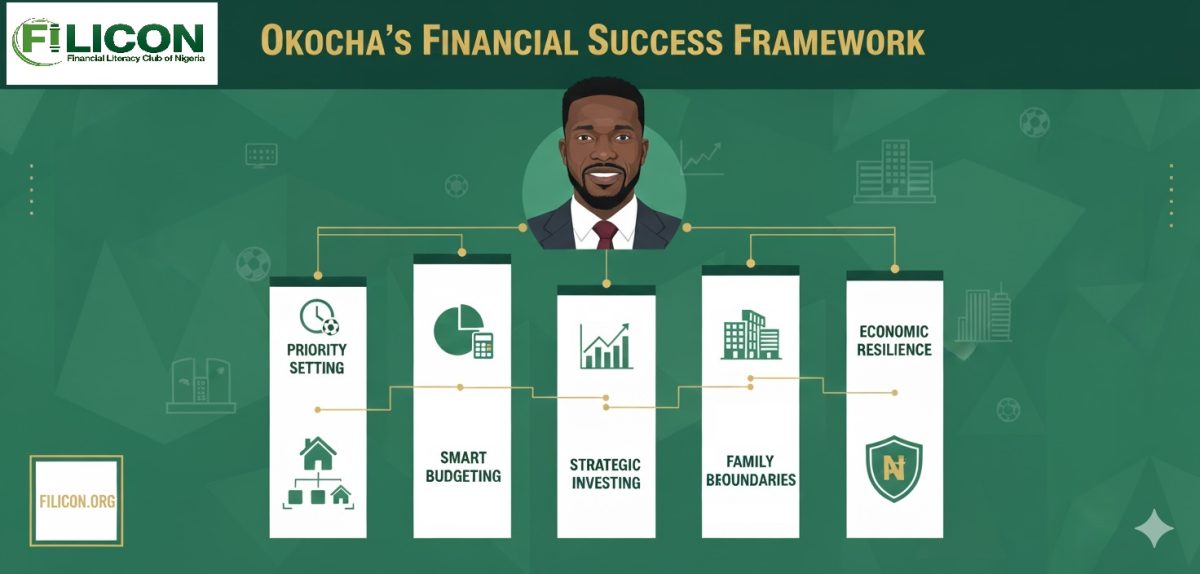
Strategic Investing: Focus Over Diversification
While conventional wisdom often preaches diversification, Okocha chose a different path – focused investment in real estate. “I said to myself, there is no need for me to be greedy and be involved in businesses I don’t understand because people bring all sorts to you, and I know that a lot of players got ripped off. I survived that because I wasn’t greedy.”
His strategy of sticking to what he understood – property investment – protected him from the numerous scams and failed ventures that have trapped many wealthy Nigerians. “The only business I was doing was property. I started deriving joy in knowing that these are my properties. So I kept on buying until I stopped playing.”
For Nigerian investors, this offers a crucial lesson: it’s better to deeply understand and excel in one investment area than to spread yourself thin across multiple ventures you don’t fully comprehend.
Managing Family Financial Expectations: Love with Boundaries
One of the most challenging aspects of wealth-building in Nigeria is managing extended family expectations. Okocha approached this with both generosity and firm boundaries: “They are part of your structure, they are part of your budget. And also make it clear to them that they have limited time. You are trying to set them up, and they have to make it count.”
His approach involved giving family members opportunities rather than perpetual handouts: “I bought houses for them, I was paying school fees for their children, so why can’t you just manage the business I’ve started for you in order to feed your family? I made sure they can never be homeless.”
This balanced approach – providing foundation and startup capital while expecting independence – offers a sustainable model for wealthy Nigerians dealing with family financial pressures.
The Cultural Advantage: Leveraging Nigerian Business Heritage
Okocha credited his Igbo upbringing for shaping his business mindset: “My upbringing, I had a good foundation in the sense that the area where I grew up, my tribe was business inclined. Most Igbos do business. I had a clear picture of what I wanted, and for me, it was all about making as much as I can to secure my future and my family’s future.”
This highlights how Nigeria’s rich entrepreneurial traditions across all ethnic groups can serve as cultural assets in building wealth. Every Nigerian community has business wisdom and traditions that can inform modern financial strategies.
Overcoming Economic Challenges Through Financial Literacy
Okocha’s success story is particularly relevant given Nigeria’s current economic challenges. His approach demonstrates how individual financial discipline can provide security even when broader economic systems fail. “From the day you stop playing, that’s it,” he observed about the lack of pension systems, yet he created his own financial security through strategic planning.
This resilience through personal financial literacy is exactly what Nigeria needs. While waiting for systemic improvements in pension systems, healthcare, and economic stability, individuals can take control of their financial destiny through education and disciplined implementation.
Why FILICON is Essential for Nigerian Financial Success
Jay-Jay Okocha’s story perfectly illustrates why organizations like FILICON – Financial Literacy Club of Nigeria – are crucial for our nation’s economic development. His success didn’t happen by accident; it resulted from financial knowledge, strategic thinking, and disciplined execution – exactly what FILICON teaches.
At FILICON, we understand that financial literacy isn’t just about personal enrichment; it’s about building a financially resilient Nigeria. Our community provides:
- Comprehensive financial education covering budgeting, investing, and wealth preservation
- Peer support and accountability to maintain financial discipline
- Nigerian-specific strategies that account for our unique economic environment
- Expert guidance on navigating local investment opportunities and challenges
- Community-driven learning where members share experiences and strategies
Your Financial Transformation Starts Here
Okocha’s journey from talented footballer to financially secure retired athlete wasn’t magic – it was the result of applied financial literacy principles that any Nigerian can learn and implement. His story proves that with the right knowledge, discipline, and community support, financial security is achievable regardless of your starting point or career path.
Don’t wait for perfect economic conditions or government solutions. Like Okocha realized early in his career, “You are your own government” when it comes to financial security. Take control of your financial future by joining a community committed to practical financial education and mutual success.
Ready to transform your financial future like Jay-Jay Okocha? Join the Financial Literacy Club of Nigeria today at filicon.org and discover how financial literacy can become your most valuable life skill. Together, we’re building a financially literate Nigeria, one person at a time.
FILICON (Financial Literacy Club of Nigeria) is dedicated to improving financial literacy across Nigeria through education, community support, and practical resource sharing. Visit us at filicon.org to join thousands of Nigerians taking control of their financial futures.